

Non-Sleep Deep Rest (NSDR): What It Is and How to Practice It
If, like me, you’re a fan of Standford neuroscientist Andrew Huberman, you will likely have heard about non-sleep deep rest or NSDR. If not, you’re about to discover something that could potentially change your life. Not only does non-sleep deep rest help restore your body, mind, and performance without sleeping, but it’s a tool that can be used to instil mental clarity, acuity, and can even rewire neural circuits.
The benefits of NSDR are vast, and it’s a practice that is really simple to have at your disposal for when you need it most. In the post below, you will find out more about non-sleep deep rest, its benefits, how it works, and why you should even care.
In this article:
Why NSDR?
Before we begin, I’m in no way stating that non-sleep deep rest is a replacement for sleep. Getting a good night’s rest is pivotal for your health and wellbeing, it is the foundation of everything. However, if you haven’t had your seven to eight hours, it is possible to still feel like your nervous system has had a break.
Non-sleep deep rest (usually shortened to NSDR) is a way to get the best of the restorative effects of sleep without actually sleeping or taking a nap. It can take anything from ten to thirty minutes, will cost you nothing, and can be done lying on your office floor if need be.
What Is NSDR? (NSDR Meaning)
NSDR stands for non-sleep deep rest. It’s an umbrella term coined by Andrew Huberman for guided relaxation practices that help bring your body into a state of deep physical stillness. The caveat is that this all happens while you remain fully conscious. You’re not asleep, but you’re not in your usual wide-awake, thinking, scrolling, doing state either. You’re in this restorative space in between.
From the outside, NSDR looks like lying or sitting still with your eyes closed, listening to a slow, guided audio track that walks you through breathing patterns and body awareness. From the inside, there is a gentle activation of the parasympathetic branch of your nervous system. A slowing of the breath, the heart rate. Your focus shifts from your busy lifestyle to your breath and various parts of your body, relaxing them as your awareness trickles over them.
If you’re thinking this sounds like yoga nidra, you’d be 100% correct. Huberman didn’t invent the practice of non-sleep deep rest, he simply gave a collective term to a number of practices that already existed: yoga nidra, yogic sleep, body scans, sleep hypnosis etc. The collective term has simply increased the reach of a practice that might have only previously been picked up by people interested in yoga, spirituality, or meditation.

Can You Actually Rest Without Sleeping?
Yes, you can. This is the crux of NSDR, and the reason it has gained popularity of late. We tend to think of being awake and being asleep as their obvious separate states, with sleep being where the restoration and recalibration happens. While this is true, NSDR can be a bridge between the two. During non-sleep deep rest, your brain shows slower-wave activity that is associated with early stages of sleep. You are still responsive and aware, but receiving the benefit of the rest.
The mechanism behind this is a shift in your autonomic nervous system. During a normal day in our wild world, we spend a surprising amount of time in a low-grade state of threat arousal. This is due to the pressure of modern-day life, our jobs, being online all the time, being switched on, always exposed to information, noise, and the stress or anxiety associated with it all.
Our heart rates remain slightly elevated, our senses slightly sharpened, and our sympathetic nervous system (the fight or flight response) is also slightly switched on, even when nothing is actually threatening us. When you think of your body having limited energetic resources for each day, being switched on all the time can use a lot of energy. This is where non-sleep deep rest acts as a dose of rejuvenation.
NSDR works by signalling safety to the nervous system. This allows your nervous system to shift toward the parasympathetic, rest-and-digest state. When this happens, your breathing deepens and slows, your heart rate lowers, levels of cortisol (stress hormone) drop. Your mind and body get to switch off momentarily, which resets your entire system.
Is NSDR the Same as Yoga Nidra?
NSDR is the broader category; yoga nidra is one specific practice within it, alongside things like guided body scans, certain forms of hypnosis, and some styles of meditation.
The practical difference is mostly in the language. Yoga nidra uses more traditional yogic phrasing and often includes setting an intention or sankulpa at the start of the session. NSDR strips that framing back so people can make it more accessible beyond the yogic or spiritual community. The underlying nervous system shift is the same whichever way you label it.

Does NSDR Work? What the Research Shows
There are numerous studies that show the efficacy of yoga nidra, which as we’ve established is a subset of non-sleep deep rest. Here are a few highlights from existing research:
A study on yoga nidra found that dopamine release increased by around 65% during the practice. Dopamine plays a key role in mood, motivation, and working memory.
Research found that practicing a 13-minute NSDR-style daily for eight weeks, improved attention, working memory, and recognition memory, while reducing anxiety around stressful tasks.
A 2024 study using a single 10-minute guided NSDR session found short-term improvements in mood and cognitive readiness, due to lower physiological arousal and mental load.
A study focusing on yoga nidra for chronic insomnia, with a randomised controlled trial, showed improved sleep in people who practiced it regularly.
What NSDR hasn’t been shown to do is replace sleep, which it never should. It can help you recoup after a bad night, it can make it easier to fall asleep by quieting the mental noise that gets in the way, and it can help you feel restored during a mid-afternoon slump. But your body still needs a healthy sleep routine to receive the benefits of what only sleep can offer.
Benefits of Non-Sleep Deep Rest
The benefits of non-sleep deep rest are clear and can be felt after one practice.
- Lower stress and anxiety, through reduced sympathetic nervous system activity
- Reducing the noise in your system to help your vagus nerve clarify the important signals
- Improved mood and emotional regulation, even after a single short session
- Sharper focus and mental acuity
- Reduced cognitive load, helping restore clarity
- Improved sleep, by quieting your mental chatter
- Faster recovery from sleep deprivation, when a nap or extra sleep isn’t an option
- Lower blood pressure and reduced tension
- A useful tool if you’ve been stuck in prolonged states of stress

Who Is NSDR For?
NSDR is for anyone and everyone, but it has specific benefits for you if you can resonate with any of the below states:
- If your stress doesn’t switch off, even when the actual “threat” has passed
- If you can’t nap without waking up groggy, or find napping disrupts your sleep at night
- If you’re a shift worker or are recovering from a run of poor sleep
- If you need a midday reset without caffeine
- If you find traditional meditation frustrating, but still want to receive the benefits
- If you’re going through change and want to embed new habits
It’s not a substitute for professional support if you’re dealing with chronic insomnia, sleep disorders, significant sleep debt, or an underlying health condition. Think of it as a nervous system reset when you need it most.
How to Practice NSDR
I’ve put together a number of NSDR practices for my breath coaching clients, here is one that you can use right now to help with balance, renewal, and restoration.
Find somewhere where you won’t be disturbed for the duration of the practice. Get comfortable. You can do it sitting up or lying down, but I highly recommend lying down to allow your body to fully let go and relax. Close your eyes and immerse yourself in the audio of the practice. Let it play through once, and then try and emulate the practice on your own the next time you try it.
Your mind will no doubt want to pull you off into different directions, but try and maintain the focus of each prompt as you slow your breathing, and bring your awareness to the relaxation of the different parts of your body.
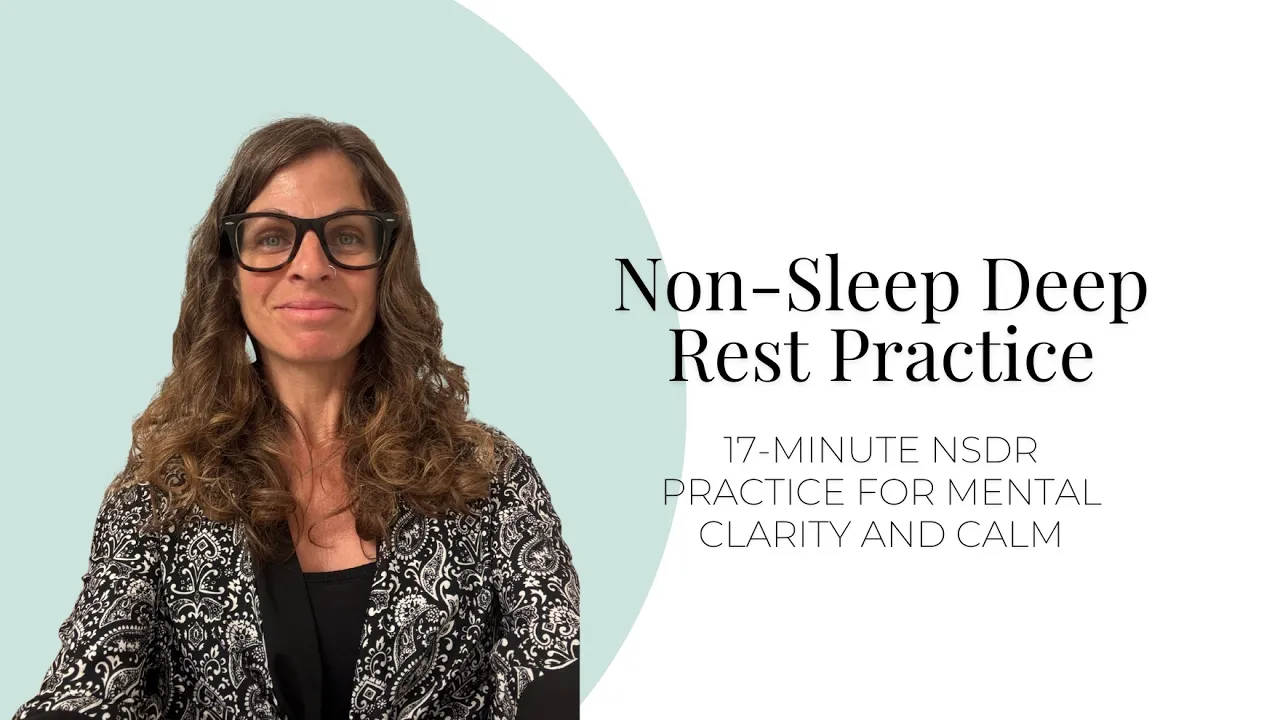
Ten minutes is enough to notice a difference. Thirty to sixty minutes is better if you’re using it to recover from a poor night’s sleep. Consistency will deliver the best results, so aim to include it in your weekly routine. Start by using a support such as this 17-minute non-sleep deep rest practice, and then try and do it yourself.
Non-sleep deep rest is an integral component of the 1:1 sessions I run with clients to help them reduce stress, anxiety, overwhelm, burnout, and to help them find balance and stability in our otherwise unstable world. Start with my free masterclass to see if it’s for you.
